With today the end of U.S. Daylight Savings, we are now 4 hours ahead of Mountain Standard Time and 2 hours ahead of Eastern Standard Time. Chilean Daylight Savings Time begins in April and ends in September.
Wednesday, October 30th, we walked home after a visit to the Institute building--very nice building, lots of youth, with four classes running concurrently!-- and followed our noses to a pastry shop.


 Chilenos boarding buses along Calle Bernardo O'Higgins in front of a statue of . . . Bernardo O'Higgins, Chile's independence leader.
We finally got a day off on Thursday, October 31st, a full-blown national holiday in Chile, including pumpkins, costumes, and trick-or-treating. The Chilenos we talked to were surprised we celebrated their holiday of Halloween in the United States, too.
We spent the day adjusting and readjusting the rather touchy washer/dryer until it got through a load of laundry without banging and thumping. The apartment is not large, so I cleaned and vacuumed all the floors and found a place for our scattered belongings in the limited storage space, after which we went out for a walk. Many stores were closed down, but we did find an open pastry shop. (Not the same one where we got the fruit tarts.)


Wednesday, October 30th, we walked home after a visit to the Institute building--very nice building, lots of youth, with four classes running concurrently!-- and followed our noses to a pastry shop.

Bread and fruit tarts. Since we were very hungry, we had to eat them all. Don't worry, Brielle, whatever I don't eat, Elder K. takes care of.

Last-minute Halloween gear for sale by a street vendor in front of the Cruz Verde pharmacy

We spent the day adjusting and readjusting the rather touchy washer/dryer until it got through a load of laundry without banging and thumping. The apartment is not large, so I cleaned and vacuumed all the floors and found a place for our scattered belongings in the limited storage space, after which we went out for a walk. Many stores were closed down, but we did find an open pastry shop. (Not the same one where we got the fruit tarts.)

Corbatitas, the bow-tie streudel, with custard-filled horns and spiral pastry. Since we were leaving the next day, we had to eat them all. It is fortunate we walk a lot every day, including getting lost most Sundays because we don't pay attention to the street signs while discussing the day's lessons. I made lentils, onions and chicken for today's lunch after our weekend of eating in restaurants.
Friday morning, Dia de los Difuntos, another national holiday, (Day of the Deceased, a day to visit your relatives in the cemetery,) we packed to go on a short trip to the south with four other senior missionary couples, the Kimballs (Concepcion Mission office missionaries), the Bensons (Concepcion South Mission office missionaries), the Baldens (nurse and apartment inspector for both missions), and the MLS (Member and Leadership Support) Pulsiphers from Chillan, to the north of Concepcion. We drove to Temuco, the gateway to resorts in the south of Chile. It was a wonderful chance to get out of the cities and see the Chilean countryside and its bountiful agriculture.

Fields of yellow rapeseed from which canola oil is made.
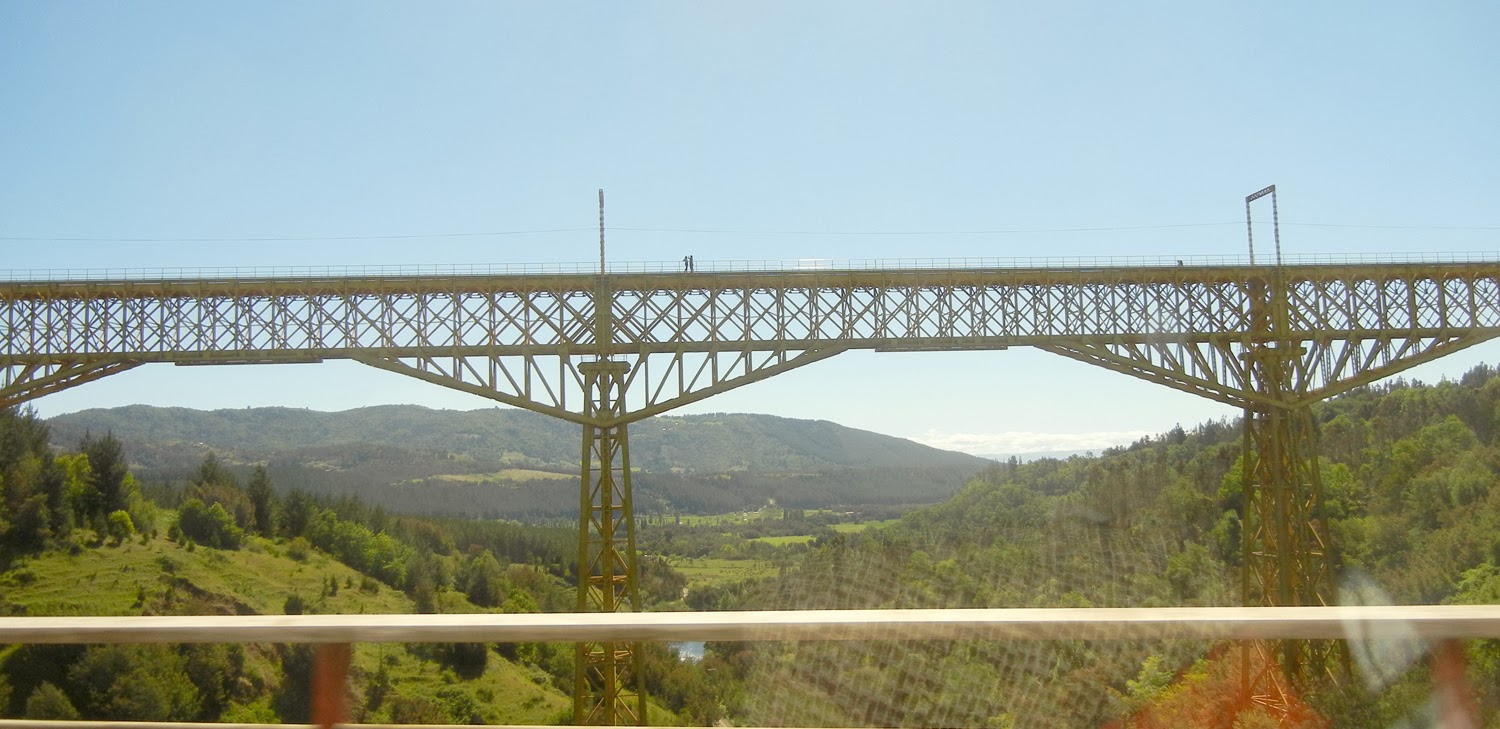
Chile's famous yellow bridge or viaduct, Puente Malleco, near Collipulli. We drove past Los Angeles on the very good toll highway.

Our first view of dairy cattle grazing on pasture near Temuco.

Where there is cattle, there is silage.

Rows of poplars form windbreaks around Chilean fields.

Elder Pulsipher called ahead to his friend Tom Woodworth, now bishop of one of the Temuco wards, to meet us at the Holiday Inn. Tom is married to a Chilean woman he met in the mission field. He had many interesting observations on Chile, and took us the "best American hamburger joint" in the country. Everyone agreed they were good hamburgers. (Sister Pulsipher, Bishop Woodworth, and I had a sliced beef gyro with Merken--a Mapuche chili sauce-- from the restaurant next door.) Although Temuco was more like an American city than any we had visited so far, it still has problems with poverty, employment, and church attendance commonly found in Chilean cities.

Overlooking Temuco at the Environmental Center

Mapuche Indian statues on Cerro Nielol
Saturday morning, we left the giant Holiday Inn bedroom--as large as our entire apartment in Concepcion--and headed for Villarrica and Pucón, a very nice resort area settled by Germans, Swiss and Austrians in the late 1800's. The region is well laid out and clean, with flowering trees and hydrangeas ready to burst into bloom.

Beautiful countryside outside of Villarrica, with one of the best fences we've seen in the country.

When the clouds lifted, we saw this spectacular view of the Villarrica volcano, Rucapillán. I have photos of the gorgeous lake along side, but I left the Nikon D80 DSLR in the Pulsipher's car, so I will have to post those later. The tree to the left with the tubular red flowers is Embothrium Coccineum, the Chilean Fire Tree.

Elder K. and I wearing our hard hats so we can descend into the lava caves next to the volcano.

The entrance to the cave.

Hardened lava flow, reminding everyone of a type of organic fertilizer we find on the dairy farm. (Our guide's reference, not ours.) We descended pretty far down, in conditions that OSHA would not approve of. But our hard hats protected us from harm.

After coming down from the volcano, the first thing we saw in the pretty city of Pucón was what we thought were banks of fresh flowers, but these are made of willow wood shavings!

Of course I had to buy some. The flowers were set in potted greenery, so the flowers themselves are on single stems. They were only $1,000 Chilean pesos each, about $2.00 for the smaller flowers and $3.00 for the large ones.

Here, an artesana shows us how she crafts the smaller posy-size flowers from a willow branch.

To pack the flowers, the stems were taken out and wrapped separately, and the flowers placed in a shoebox.

Family bicycling along the large park in the middle of Pucón. Many Chileans living here are taller and blonder than those in the cities north.

After lunch at a restaurant owned by an American expatriate from Virginia, serving pork ribs with actual barbecue sauce, (a rarity in Chile,) we found our way to the many and ongoing ferias artesenales.

I bought a beautifully made breadboard for $4,000 Chilean pesos (about $8.00), and a pair of silver earrings made by Mapuche Indians with a distinctive design. Mapuche silver jewelry often includes interesting hinges and dangles.

I earlier bought this bag with Mapuche braidwork in Valparaiso. I use it to carry my knitting and crocheting. We got back to our apartment at about 9:30 and went right to sleep.

Hermana Maria Conejo and some of her children soaking up sun on the church steps on Sunday. (I'm not sure which girls are hers.) Her younger son and husband are still in the chapel. The Conejos are an Ecuadorian family who have been through many tribulations but are steadfast and faithful. Maria helped me find the best yarn shop in Concepcion.
Elder Kennington and I have now seen more of Chile in two weeks than most of the other senior missionaries have in over a year of serving here. Our supervisors told us to get to know the country! We're glad for the chance to do just that. Hopefully we will be able to visit more in the future.


