Sunday, September 14, 2014

Tomé and a Remembrance

September 7th we visited the Frutillares Branch in Tomé, on the coast of the Bay of Concepción north of  Penco and Lirquen.

I forgot to include this photo in last week's post. Before we left Salto del Laja, one shop opened up, and I found these lapices - crayon pencils made of small branches - for grandchildren. Who cares if they even color very well.

Sunday morning was gray and rainy. There was a big squiggle in the map we printed out, and it ended up being the old highway which had several hair-raising backwards curves, while going sharply downhill toward the ocean. The return highway was a real improvement.

Tomé along the ocean front

The Frutillares Branch building. All the meetings were timely, and the members were soft-spoken and reverent. During breaks between meetings, the members sang hymns in the chapel. It is one of the most musical places we have visited in Chile.

The chapel itself was well cared for and pretty. The building was remodeled and actually has central heating. Romy, who attends this ward, sang a duet with her music director, who was playing the keyboard as well as singing harmony.

Driving along the highway out of Tome.

Ships in the Bay of Concepcion.

Marker for the commune and municipality of Tome.

Sign for falling rock along highways cut through the hills.

Neighborhoods of housing built after the earthquake, which struck Tome hard.

South of Tome, north of Penco, is the municipality of Lirquen along the coast.

Above, carabineros making their presence known on Calle Serrano. We saw big  green tank-like trucks on the street for several days. Wednesday, after a Planning for Success workshop, Manuel and Andrea walked us home, for safety's sake. I had sent to Salt Lake for their patriarchal blessings, which they lost during the earthquake, and printed copies for them,which they let me read. It was touching to know that other people would be blessed to help them achieve their goals, which Elder K. and I feel a part of.

We were warned by several people, including my Chilean cousin Hno. Rojas, whom we met on the street, our concierge Galvarino, and Hna. Rosas, that we should stay home the whole day on Thursday. September 11th is the anniversary of the 1973 coup d'etat installing murderous dictator General Augusto Pinochet following the assassination of the  Marxist president Salvador Allende. Many of our friends keep their children home from school. All LDS church employees were sent home at 2:00 p.m. There is a history of anarchists using the anniversary as an excuse for violence against foreigners, and Chileans.  It was an otherwise beautiful day, so for exercise we walked up and down several flights of stairs. We watched remembrances of our own September 11th anniversary on the Internet, the terrorist attacks on the Twin Towers in 2001.

On Friday we saw our friend the street attendant on Chacabuco, to whom Elder Kennington gave a copy of the Libro de Mormon. He told us students and anarchists had blocked the street and lit fires, and 70 people from around Concepcion ended up being jailed overnight. During the week there was a bombing in Santiago, the murder of a young American teacher in Temuco, several alcohol-related deaths of students in Concepcion, and other problems with violence. We were glad when the week was over.

Meanwhile, I found a red-white-and-blue delantal - apron - with its Lone Star of Chile, along with other decorations in preparation for September 18th's national independence day. 

Friday an enthusiastic group of elders and sister missionaries from the Concepcion South Mission came for a Self Reliance workshop .  One of the elders asked about taking the OPIc English language test since he has been using the Companionship Language Study grammar books to prepare for it. Another thing I need to learn about: http://learningenglish.mtc.byu.edu/

 
I gave my green Mapuche-style wall hanging to Andrea for her September 11th birthday since she admired it so much. I made a new one, but I hung it on the wall in our apartment. Now everyone asks what happened to the one that was hanging in the office. Apparently once something appears on the wall,  it needs to stay there.

A rug I crocheted on September 11th out of recycled yarn. I was going to give it away, but I may wait until the cold weather is over.

Sunday, September 7, 2014

Los Angeles & Salto del Laja

The last Saturday of August we drove out on Ruta 5 south for Los Angeles, a city of about 185,000 situated between the coast and the Cordillera. It is a farming region, so when Elder Kennington saw farm equipment dealers on either side of the highway, he started to feel at home.

It isn't ConAgra--it's Coagra, but Elder K. was impressed by the big tractors.

We even passed -- wait for it -- a silage pit covered with plastic sheeting and tires. Vanessa, Carrie, Conrad, Casey and Jeff will know all about this.

We stayed two nights at the Diego de Almagro, which needs to change the address on its website and on Google Maps. Fortunately someone told us where to find it.

We keep seeing silver crew cab Nissan pickups wherever we go in Chile, just like Wendy's Troca de Plata. Here it is again, parked next to our Outback in the hotel parking lot.


We ventured into Los Angeles, which we were told has spectacularly bad traffic, especially in the center of town, which is where we are, above, on Avenida Colon. Still, Los Angeles is more spread out and there aren't as many tall buildings as in Conce, for which we were grateful.

We located the Los Angeles North Stake Center so we could find later it among the winding one-way streets. We met with the stake president and the Self Reliance Committee for an informational presentation, which went very well. Sunday evening we met with another group of people interested in applying for Perpetual Education Fund loans.

The Pendleys, who come to Los Angeles regularly on South Mission business, told us they prefer the Verona hotel, so we stopped there for lunch at the otherwise empty restaurant.

Outside there were banks of blooming poinsettia shrubs losing their red bracts. The Chileans call poinsettias  the Corona de Inca, Flor de Navidad, Flor de Pascua, or Nochebuena, their name for Christmas Eve.

Elder Kennington ordered a sliced beef sandwich with porotos verdes, green beans. My sandwich was the same except with paltas, avocado. It was delicious.

Sunday morning we got lost looking for the Barrio Galvarino chapel, which the stake president had asked us to visit. Fortunately we came upon these elders walking along the street, and they showed us where it was. This happens to us often. They were thankful for the ride.

The chapel where the Galvarino Ward meets, which it shares with another ward. Something more common outside of Concepcion.

Following the meetings, we were invited to lunch at the home of Stake President Pauvif, who happens to be the head of Promasa in Chile, a wood-products business owned by friends of ours at home in our Ontario 3rd Ward. Two hungry elders had also been invited. Fortunately, Hna. Pauvif is a terrific cook, and she cooked a LOT of food for us.

I love the hanging photo display.

Following our dinner of vacuno, beef--a cut called choclillo, which Elder K. says is the best he's eaten so far--chicken, peas, choclo (sweet corn), salad, and "pie limon," which is a round vanilla cake topped with lemon-flavored meringue, all very delicious, the elders left us with a message from the Book of Mormon.

The handsome Pauvif family. Hna. Pauvif has a delightful laugh, and we had a very funny conversation. They have traveled widely, including to our very own Treasure Valley in eastern Oregon.

 
Monday morning we left Los Angeles reluctantly.  We kept telling each other "I really like it here!" and how we wished we could stay. At the crest of the hill driving out of town is the famous Cross landmark. We never did locate the Promasa plant, which means it's very easy for anyone except gringos to find, or the El Rincon Bed and Breakfast which is supposed to be just off the highway. Some other time, I guess.

Another reminder of home. I do like the windbreak poplars, which mark the boundaries of fields. 

 
Fortunately there were lots of signs for Salto del Laja, the Falls on the Rio Laja, so we were able to find it. Since it was quite cloudy and rainy, we had the place all to ourselves. We were early enough that the feria artesanal sellers had not yet set up their shops, which Elder K. was thankful for.

The Falls were big, loud and spectacular, with all the rain this winter.

 The fine mist on my camera lens makes the picture a little blurry.

 Here I am, also a little blurry, which is not a bad thing.

Thursday afternoon we made a return trip to visit Hna. Truxell, who is doing much better. The cancer surgery was successful, and she and her husband will be leaving their Conce apartment for the U.S. next week. Above is a photo taken from their pleasant apartment balcony.

A photo of Elder K. visiting with the Truxells, if only to remind myself of how much nicer their apartment is than ours.

Friday Andrea did not make it into the Centro for her weaving class, since her mother in Coronel was very sick. Manuel's father was in the hospital in Los Angeles as well, so he didn't make it to the Planning for Success Workshop since he wants to sign up for a PEF loan. We were going to celebrate Andrea's birthday this week, but that will be on hold for now.

Above, one of the ladies shows a page from her weaver's notebook, very typical of Chile. She has a design for a poncho, the yarn she is using, and the tag from the yarn so she can find it again.

Our favorite weaver working denim yarn into her squares.

Our felting teacher has, naturally, turned out to be an outstanding weaver. Here she shows several dresses she has made, which she has joined and decorated with crochet.

A poncho she has decorated, naturally, with a very pretty white wool felt flower.

In the Corta y Confeccion class, Hna. Dagnig shows us a dress made for dancing the Cueca. Since the Chilean Day of Independence comes up on September 18th, all the stores are now stocking child-size cueca dresses and ponchos, and red-white-and-blue table decorations. 

More Lirios de Cala, Calla Lilies, Zantadeschia Aethiopica. 

Sunday, August 31, 2014

An Official Visit

Elder Kennington and I now have eighteen grandchildren! Nine girls and nine boys. Saturday morning, Jeff's Brielle gave her two little boys a sister, Junette Elizabeth. Since we have been on our mission two others have been born: Casey's Katie gave birth to the handsome and dimpled Isaac, and Jon and Carrie welcomed sweet-cheeked blonde Brynn Lee into the world on our May 10th anniversary.  We feel very blessed.

A week ago Sunday was the Concepcion Stake Conference, which we attended so we could visit many of the people we have met over many months. We were glad to see several who had come to the Centro for help and were now, in fact, employed.

 Following Stake Conference, we attended the baptism of Marcia's mother and grandmother, seated above with the father of the family, one of the sisters and a grandson. Often Chilenos will pose stoic and unsmiling for photographs, although Elder Streadbeck and Elder Encarnacion, seated next to him, weren't afraid to show how happy they were. The water in the font, unfortunately, was not heated, and it was an act of faith and courage for the bisabuela, who does not walk very well, to descend the steps into the cold water to be baptized.

 
During our weekly trip to the Unimarc on Chacabuco, we saw another of these carts of the very large stalks of an unknown plant. People buy these and chew on them like sugar cane, although we are told they don't have much flavor, even when you sprinkle salt on them. We asked the smiling vendor what it was and she said, "Nalca," a medicinal plant known as the Chilean rhubarb.

 Above is a photo of the Gunnera Tinctoria plant, with its long stalks, called Nalca, and large leaves, called Pangue. The leaves are used in cooking the national dish Curanto in a hole in the ground with charcoal and lined with rocks. The leaves protect the cooking food and add moisture. Medicinal qualities include helping with problems of the liver, hemorrhaging, diarrhea, stomach, and fever.
This week a large group of mostly North American, mostly sister missionaries was going home just in time to attend Brigham Young University, after spending a day at the Centro for a Self-Reliance Workshop. The missionaries have named this workshop "Introduction to the Real World," following 1 1/2 to 2 years of living only to serve others. Here they are waiting for the mission vans to pick them up in the fresh and brilliant sunshine of late winter in Concepcion.

On Wednesday we had an official visit from Brian Gibson and Dane Nielsen from Salt Lake City, along with Alejandro Calquin, PEF operations manager in Santiago. Brian is the interim South America South manager for Self Reliance as he travels the area visiting Centros and interviewing candidates to replace the outgoing manager. We gave presentations on what we have been doing for the last several months. Elder K. and I were able to have a nice chat in English with Brian and Dane before they left. They were very complimentary, especially of the work I had been doing developing materials and building the blog for volunteers and specialists. It was a good day for me.

 Romy made the executive decision on where to have lunch, and she chose well--the new Rosa Amelia restaurant down the street. The ambiance was elegant, the food was excellent, and prices were reasonable. We will be back.

A sister from Hualqui stopped by the Centro, showing the woven articles her husband had made. She and her husband had taken a weaving class, and while he does the actual weaving, she takes care of marketing by stopping at offices and ferias wherever she can and showing her wares. Above, Romy models a very soft and beautiful manta, a blanket-like cape made on a Telar Maria table-top loom.

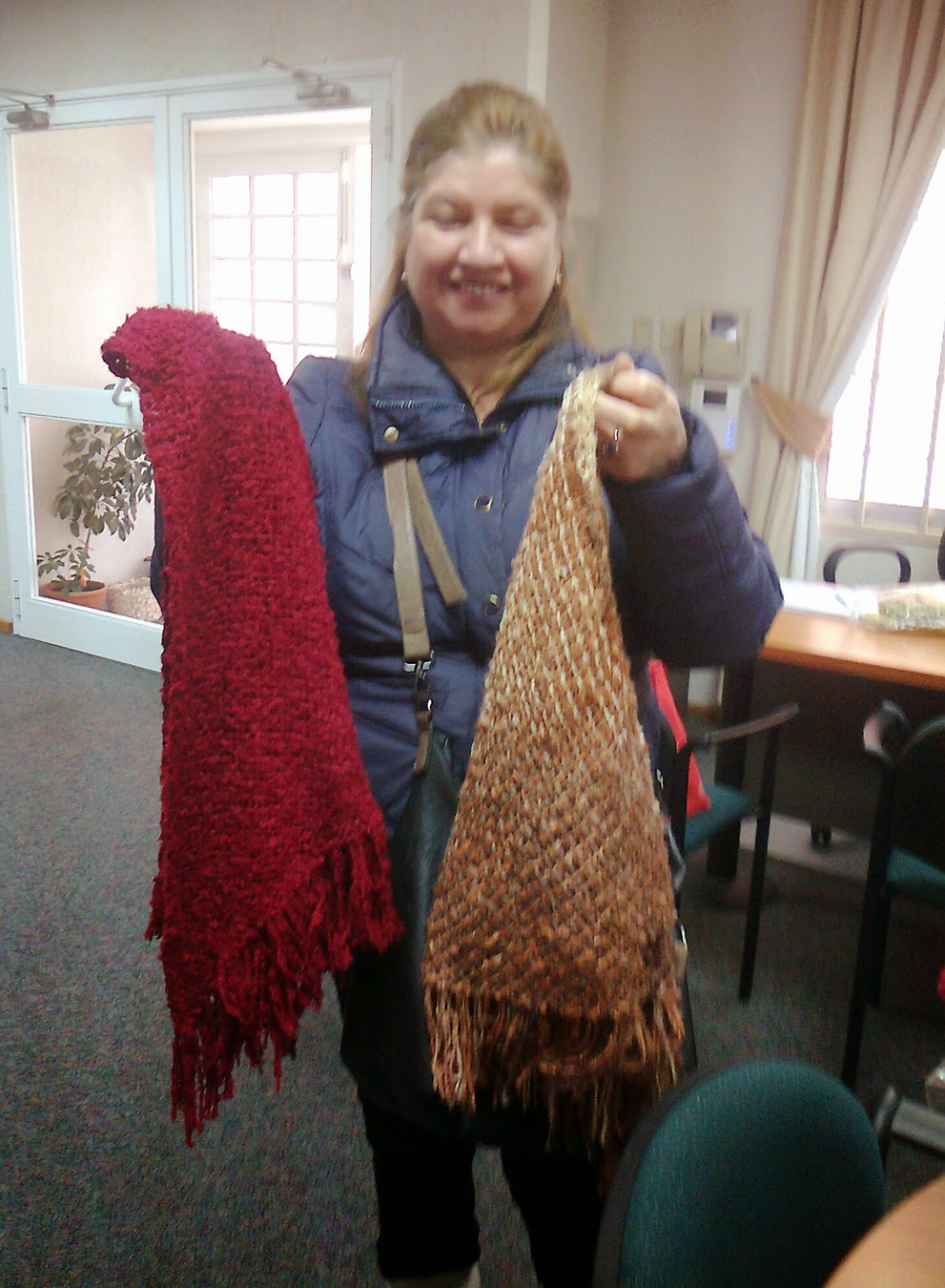
Vendedora Silvia Saez holding the two triangular scarves I couldn't resist, which I bought to give as gifts. Maybe.

Friday the Pendleys invited us to a restaurant they found not far from the mission office, Quinche y Sabor, on Calle Prieto between Lincoyan and Rengo. It was an unlikely location, but there was parking! Sabor means flavor and Quinche is a term used in the cone of South America, meaning "steak restaurant."

The place was decorated with antique sewing machines and irons. It makes me tired to look at them.

We ordered the day's special, including crab soup, exquisitely cooked crepes with sliced vegetables and chicken, and fresh raspberry lemonade. The surroundings weren't as fancy as Rosa Amelia, but the food was just as good.

Friday night, Andrea showed us her latest creation for her son, a poncho woven and decorated in the Mapuche style. Behind her, a young married couple is on the computer as they make an online application for the Perpetual Education Fund, while Elder Kennington is in the classroom teaching the Planning for Success workshop.

I finally finished my Chile Telar of Chilco, the Chilean Fuchsia Magellanica. When I brought this to the Centro to show everyone, Hna. Rosa had to wipe away a tear. It affects her emotionally that I should spend so much time and energy making something beautiful, and so representative of Chile.

We have been asked by Salt Lake to develop short presentations on Best Practices for other missionary couples, including taking videos of learning local crafts, teaching how to crochet rag rugs, basic computer lessons, etc. I am beginning again with the famous Copihue wall hanging so I can record step by step instructions.

Here with the warp yarns in place, anchored to the frame in three places, and beginning the bordado, the embroidery-type stitch I am using to produce a raised color to highlight the flowers to come.